Unusual archaeological finds dating back to AD 200 have been discovered in a field near Royston. The artefacts, which form part of a burial, probably of a wealthy and cosmopolitan individual, are a unique find in Britain and experts in ancient finds are already clamouring to study these rare objects.
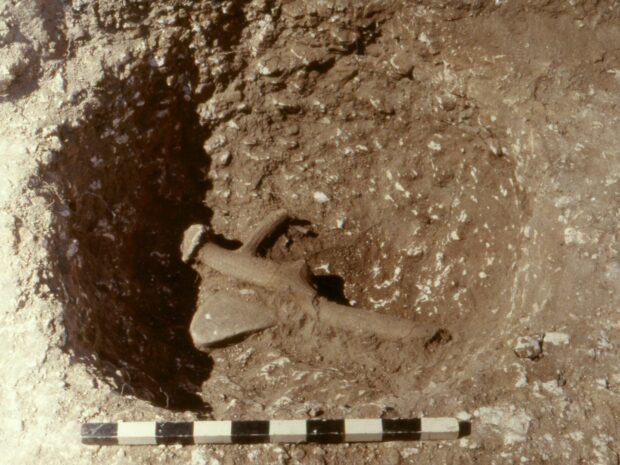
Discovered late last year by a local metal detectorist in a field in Kelshall, a complete Roman jug was the first thing to be found. A bronze dish, a larger jug and then a third jug were soon uncovered. Realising this was an important find it was reported and Keith Fitzpatrick-Matthews, North Hertfordshire District Council’s (NHDC) Archaeology and Outreach Officer, decided that it would be a good idea to investigate further.
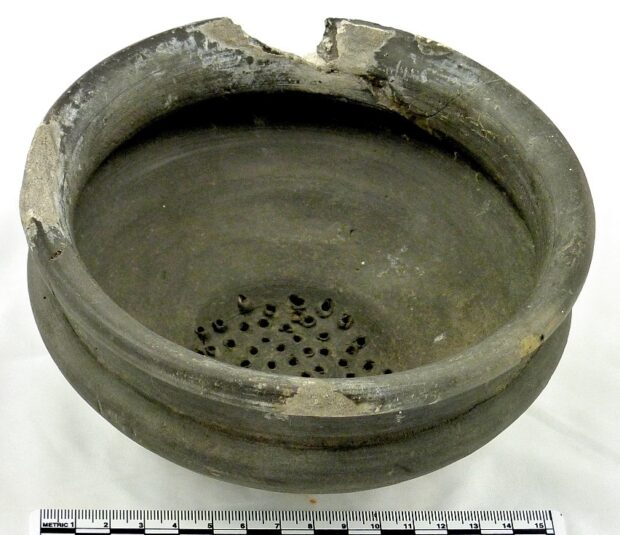
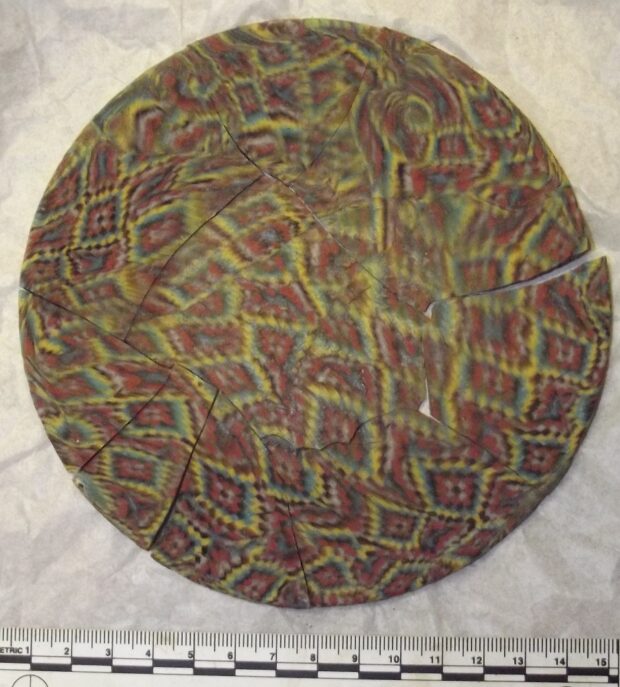
Once the dig was underway, glass bottles, an iron lamp and wall mounting bracket, two layers of hobnails from a pair of shoes and a box with bronze corner bindings were uncovered. Two shattered, but otherwise complete, mosaic glass dishes stood on top of a decayed wooden box which held two broken clear glass cups and a pair of blue glass handles. The largest glass bottle was hexagonal, and contained cremated bone and a worn bronze coin dating from AD 174-5. A rare octagonal bottle stood next to it. A major find was mosaic glass dishes likely made in Alexandria, Egypt, around AD 200
Currently owned by the farmer and the finder, the North Hertfordshire Museum Service hopes to raise the money to buy the finds, so they can be displayed when the new museum opens later in the year.
After 1800 years, finds like these still impress us with their workmanship. Working together with the metal detectorist, NHDC’s archaeologist and the Finds Liaison Officer, were able to uncover the past and find out and understand so much more about the lives of people in Roman North Herts.
As you open your Christmas cards this year, imagine opening one like the one above, beautifully embroidered by hand, and sent to you from the front line of the First World War. This card helped to connect soldiers to their families at home, and they would have waited eagerly for a reply.
Silk postcards grew in popularity from 1915, though they first appeared around 1900. Some estimates suggest as many as 10 million cards were produced during the First World War.
Each card was produced as part of a cottage industry which saw mostly women engaged in intricate designs being hand embroidered onto strips of silk mesh, the design being repeated as many as 25 times on a strip. This was then sent to a factory for cutting and mounting as postcards and greetings cards. The cards themselves were bought from civilians trying to scrape a living from supplying soldiers’ needs in the immediate war zone. They were not cheap, each one costing as much as three times the daily pay of the average soldier. Although they are postcards, they were often sold and sent home in an envelope to protect their contents.
There is a huge range; some had sentimental messages, such as “friendship”, “birthday greetings”, “Home Sweet Home” and some cards celebrated festivals and holidays. Many had delicately opening pockets with a small card insert. Others would give “Greetings from France” or poignant messages “from the trenches”.
Today this card connects us to events that occurred 100 years ago, and reminds us of the people who were not so different from us.
Visitors took the opportunity to join the last Behind the Scenes tour at Letchworth Museum on Tuesday 2nd December. This was the last time we will run the tour so that staff can concentrate on all the tasks necessary to move into our new building next year.
Those on the tour heard about the history of the museum building, the first part of which was built 100 years ago this year.
Staff working on processing and packing the objects showed them what they have been doing.
Our visitors saw how many boxes we’ve packed so far, stored around the museum building.
Although this was the last tour of Letchworth Museum, there is still time to book onto the last Behind the Scenes tour at Hitchin Museum, which is on Friday 19 December at 10am. To book a place please call 01462 434476 or email hitchin.museum@north-herts.gov.uk.