Connecting Collections – Exploring our Shared History
Connecting Collections is a free exhibition curated by local people in North Hertfordshire and has been put together as one of the outcomes of the museum’s Connecting Collections project, which aims to:
• Include histories from local people of global majority backgrounds, who are currently underrepresented in the museum. By global majority we mean people who identify as Black, African, Arab, Asian, Brown, mixed-heritage, are indigenous to the global south, or, from communities often described as ethnic-minorities.
• Look into how some objects were collected, including whether any were obtained in unfair or unethical ways.
• Examine the way items and histories are described in the museum, and make changes to give a fuller picture of history.
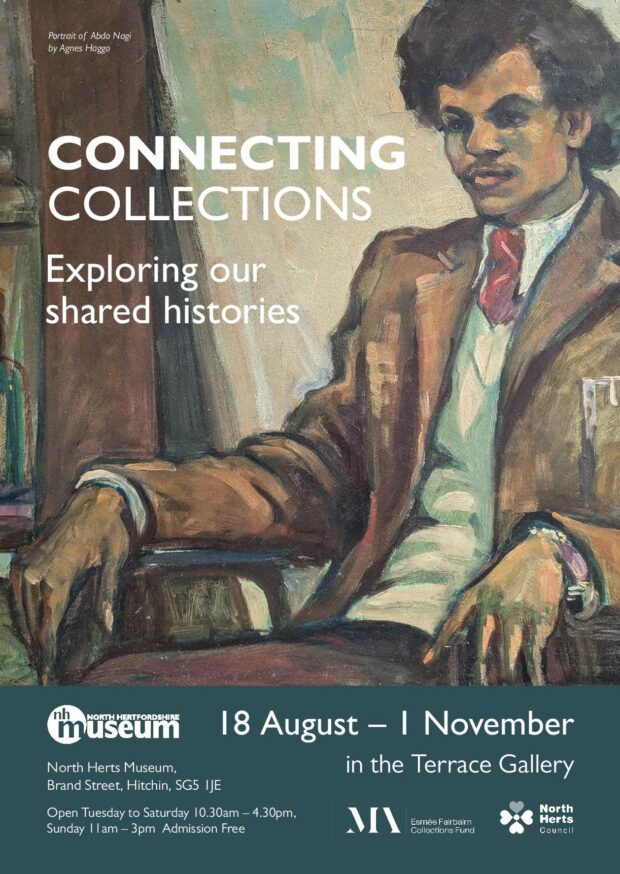
Image: Portrait of Abdo Nagi by Agnes Haggo, c.1967
North Hertfordshire Museum…
…recognises the role it plays in shaping the world around us, and that if we only include white or colonial perspectives, this can perpetuate racist ideas and inequalities in our society. Through ten weeks of workshops, participants engaged in activities that aimed to steer change at the museum, and we are proud of the work done by everyone who took part. Participants explored the museum collection to find objects they felt personally connected to, then chose an item to display in the exhibition.
Following on from this exhibition, and guided by participants’ ideas, the museum will continue to make the displays more inclusive, so there’ll be more for everyone to experience, learn and celebrate.
Recorded histories
The Connecting Collections participants made recordings of their family histories and migration stories. These recordings have been added to the museum collection, you can listen to them here:
Dakarlian shares the story of his mother’s journey from Jamaica to Britain as a teenager in search of opportunity and independence. Through her experiences, he reflects on family, cultural identity and the lasting contribution Caribbean communities make through their resilience, community spirit and traditions.
Grace reflects on her parents’ journey from Jamaica to Britain in 1955 as part of the Windrush generation, answering the call to help rebuild the country after the war. She shares their experiences of hardship and discrimination, while celebrating the lasting contributions Windrush communities have made to British society, culture and public services.
Jas shares his family’s journey from rural Punjab to Hitchin in 1969, following his father’s service as a Commonwealth soldier and search for better opportunities. He reflects on leaving behind home and community, adapting to life in Britain, and overcoming the challenges of racism, identity and belonging.
Rajshree shares her journey from Uganda to Britain as a child following the expulsion of British Asians in 1972. She reflects on the challenges of displacement and racism, alongside the kindness, resilience and opportunities that helped her build a life, family and sense of belonging in the UK.
Sahiba shares her family’s journey from Punjab to East Africa and eventually to Britain, tracing generations shaped by opportunity, displacement and migration. Reflecting on identity, belonging and assimilation, she explores how these experiences connect her story to those of many South Asian families in the UK.
Rohwan shares the story of Amanda Berry Smith, a former enslaved woman from the United States who became a renowned gospel singer and preacher. Focusing on Amanda’s visit to Hitchin, he highlights how Smith’s message of hope, faith and perseverance left a lasting impression and demonstrates the positive impact migrants can have on local communities.
Tricia reflects on her family’s journey from Shanghai to Hong Kong and then to Britain, shaped by war, political change and personal loss. She shares a deeply personal story of migration, identity and belonging, exploring the challenges of growing up between cultures and finding home in more than one place.
Content warning: in this recording, Tricia talks through her experience of hearing racist slurs.
This project is funded by the Esmée Fairbairn Collections Fund.
The Esmée Fairbairn Collections Fund is run by the Museums Association, funding projects that develop collections to achieve social impact. Since its launch in 2011, it has awarded 178 grants totaling over £12.9 million.